Room 10 @ Ruapotaka held a Chromebook celebration last Thursday to engage with family and whānau and in order for learners begin taking their Chromebooks home to experience ubiquitous learning. To strengthen connections with whānau, two of the Manaiakalani team, Fiona Grant (Professional Learning Team Lead) and Yayleen Hubbard (Kaiarahi/Whānau Engagement Facilitator) offered support at this hui.
Creating
Students were actively engaged in preparing for this event by creating personal invitations for whānau. A small group of students also created a video invitation in English, Māori, Samoan and Tongan to maximise whānau understanding and involvement. To encourage learners to reflect upon the transition from homework to learning at home through this digital affordance, each student created a screencast to share with their families how and why their learning would benefit by taking a Chromebook home. Here is an example shared through individual learner blogs.
Sharing
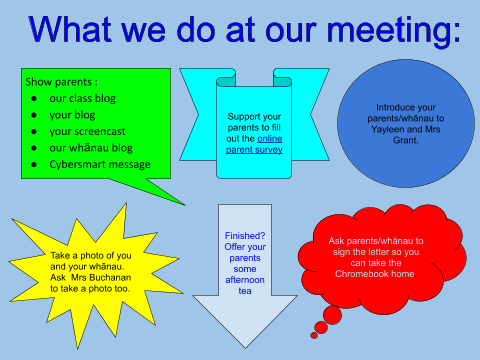 Each student led the experience for their family. To promote student independence and agency, learners were scaffolded to present learning and work through a series of tasks and activities with their visiting whānau.
An important aspect of this celebration was gathering data from whānau through a whānau survey to gauge attitudes to learning at home, and information about digital learning, use of public libraries and languages spoken at home.
Overall the celebration was highly successful as a model for engaging with whānau. Although there are a few students in Room 10 who have yet to complete the paperwork to purchase a Chromebook, only one family (of those students with a personal Chromebook) was unable to attend.
To reflect on this event, all students have been asked to write about their experience at our Chromebook celebration: here is Alexandra's writing. It is poignant that at this exciting and unique milestone event in their digital learning, a highlight for many students was sharing afternoon tea.
Learning
Through this Chromebook celebration, I have learnt that:
Learners co-operated and collaborated with new-found confidence when creating the various DLOs for this event as it represented a significant milestone in their personal digital learning journey.
Parents were excited to come and see digital learning in the classroom and excited that their child was able to begin learning at home using a Chromebook.
All learners were proud of their achievements and proud to share their digital skills with their visitors.
Google does not offer translation into Tongan.
Learners need a password to access the Tamaki Learning Network (TLN) on their Chromebooks at home!
Next steps
Learners will create additional screencasts to support whānau engagement with their child’s digital learning. Additionally, primary caregivers will attend some initial training with the Manaiakalani Kaiarahi/Whānau Engagement Facilitator to enable learners to take Chromebooks home more than twice per week. While maintaining relationships with family, it is now time to begin addressing the reading aspect of my Spark-MIT 2016 inquiry.


