Pages

Showing posts with label Room 10 @ Ruapotaka. Show all posts

Saturday, 18 February 2017

Spark-MIT 2016: Reading over the summer holidays


As our new school year has begun with students heading into new learning in new environments, some questions remained about the reading habits and opportunities over the summer break for Room 10 @ Ruapotaka 2016 for my Spark-MIT inquiry.  How much reading was undertaken over the holidays? Did students participate in the Summer Learning Journey?  What levels of engagement were evident?  What has been the impact on reading achievement?  How were whānau engaged in supporting reading over the summer?

By December 2016, 15 learners remained in Room 10’s control group for this inquiry. Of these, four actively participated in Manaiakalani’s holiday blogging programme, the Summer Learning Journey: two learners published 20 posts each; one learner shared 18 posts; and the fourth student published seven posts.  Three of these learners had access to the internet and a digital device at home while one learner visited the public library to complete all blogging activities.  It should be noted that there were barriers to student participation in the Summer Learning Journey as all student chromebooks were kept at school over the summer.  Also, anecdotal evidence from students suggests that a number of families and whānau who actively support their children’s learning do not permit them to visit public libraries in the area to use the computer facilities for blogging or reading as they are viewed in a negative light.

On returning to Ruapotaka in February 2017, the Room 10 2016 control group was reduced further to 10: three students had moved to other schools and two students remained on holiday in Week 2 2017.  Three of these five students were active bloggers on the Summer Learning Journey but were not available for reading assessments.

Of the students assessed in February 2017, Student A’s reading level increased by six months between November 2016 and February 2017. He was an active participant in the Summer Learning Journey and engaged with digital texts at home online throughout the summer.  He made accelerated gains in reading between November 2015 and November 2016 and these were extended to a reading age of 10.5-11.5 during the 2017 summer holiday.

Student B’s whānau values reading and there is a collection of books to read at home. Student B read these “a couple of times a week” during the holidays but had no access to the internet or a digital device, nor was he allowed to go to the library.  Student B reads above his chronological age and maintained his reading age of 11-12 from November 2016 to February 2017.

Three students read books occasionally over the summer, either at home or at the library, and the reading age of all three declined by six months between November 2016 and February 2017.

Two further students did no reading at all over the summer holiday and it was determined that their reading age dropped by 12 months between November 2016 and February 2017.

To conclude, all students who engaged with reading over the summer, whether in digital or book form, whether they maintained their reading age or experienced some summer drop-off, were curious and self-motivated learners who enjoy reading, whatever their reading ability.  Significantly, those who were summer readers all received some level of support or positive encouragement from whānau.

Sunday, 18 December 2016

Celebrating Success

Our inquiry focus for 2016 has been "From Challenge to Success". We have certainly faced our share of challenges this year. Seven learners left Room 10 between the end of 2015 and Term 3 of 2016. One learner returned to Room 10 at the beginning of the year after spending one term with us earlier in 2015. Five learners were moved into Room 10 from another class in the middle of Term 3. These changes impact learners on a day-to-day basis in terms of friendships both inside and outside school, and relationships with others, for example within reading groups. Additionally, Ruapotaka was adversely affected by asbestos risk during Term 3, the result of which was we were moved to a nearby primary for a few days. On our return to Ruapotaka, Room 10 continued learning in the school library for three weeks. The resilience and "can-do" attitude to problem-solving displayed by most students during these changes and challenges was heart-warming and positive for their ongoing learning.

So how did we approach celebrating success in Term 4? Working in small groups, learners were challenged to create a movie to demonstrate how we celebrate success or what success means to them. The purpose of this was two-fold: to promote greater collaboration within small groups; and to offer learners the opportunity to plan and create their own movie whilst learning some basic editing skills in Movie Maker. Supporting resources were shared via Room 10's class site: How do we celebrate success? Each mixed-ability group brainstormed and recorded their ideas, from which plans were formulated.


More detailed planning took place via a shared Google doc and the end result of collaboration, learning and creating was four completed movies which have been shared on the class and individual blogs. Only one group needed some teacher support and a slight adjustment to their plan to meet end-of-term deadlines. Learners overcame challenges and worked together in a positive way to achieve the team goal and were excited by the opportunities offered by these learning experiences. As well as having some beginning experience of creating and editing using Movie Maker, many learners explored different options for creating their own beats, music and animations to enhance their movies.


Some learners shared their thoughts after the movies were made:

Friday, 19 August 2016

Spark-MIT 2016: a milestone for whānau


Yesterday, digital training to empower whānau within Manaiakalani was undertaken for the first time by a family at Ruapotaka. After much persistence on the part of the student, a one-on-one training session was organised between a parent and Yayleen, Manaiakalani's Whānau Learning Kaiarahi. Alexandra's mum spent an hour with Yayleen learning about kawa of care and setting up a personal email account.

It has been two months since our Chromebook hui, but this significant meeting is further evidence that whānau do want to engage with and support their child's learning. As well as being a milestone for whānau, it was a proud moment for Alexandra too. She is now able to take her Chromebook home more frequently: Training with Yayleen. Time will tell whether other learners follow Alexandra's model to facilitate such whānau meetings!

Tuesday, 16 August 2016

Spark-MIT 2016: Literature Circles

I am inquiring into how learners in my Year 6 class can make and sustain accelerated gain in reading. Based on my observations and conversations with learners, all fluent readers enjoy reading but do not always actively choose to engage with longer texts independently. Despite some barriers to these learners accessing a range of relevant and interesting books, there are also personal mindset barriers which impact which books learners choose to read and how learners attempt to sustain reading a longer chapter book.  


According to the Ministry of Education, a literature circle is an approach to teaching reading that encourages fluent readers to think about and discuss books, usually longer texts. In such a “book club” a small group read the same novel independently, coming together at certain times to share their opinions, feelings and thoughts with the rest of the group.


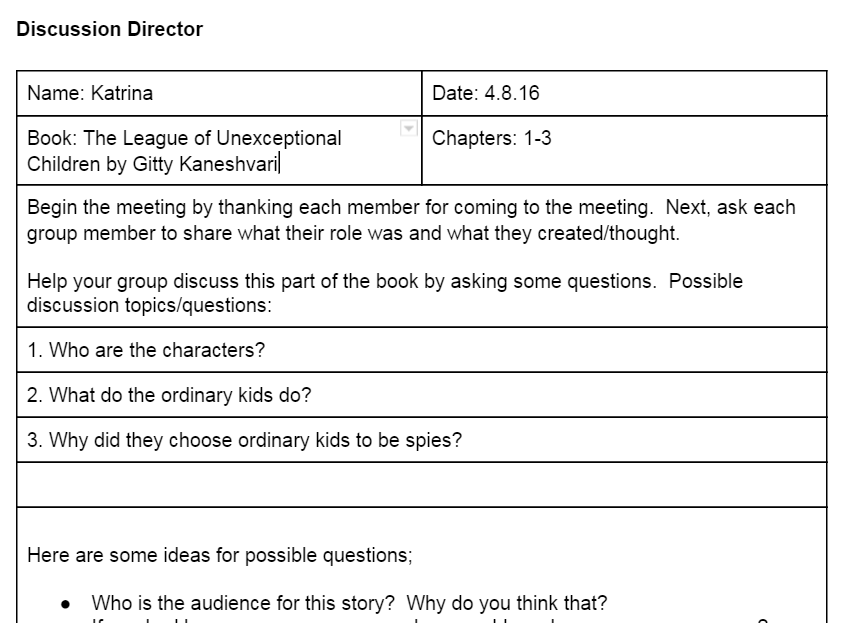
Within the context of this inquiry, one reading group has been introduced to literature circles this term to investigate if this teaching approach can foster independence and deeper connections with a longer text amongst fluent readers. The group has taken on different roles using literature circle resources devised by Sheena Cameron.

So far, the response has been positive: learners have worked together to clarify roles and provided support to others when preparing for their first meeting - at which they enjoyed rich discussions led by the Discussion Director.


The learners are creating and completing their designated tasks digitally, although this can only be described as substitution within the SAMR model at present. However, the visible co-operation, collaboration and purposeful talk are supporting the growth of actively-engaged learners who, it is hoped, will choose to persevere to become resilient independent readers over time.

Saturday, 23 July 2016

As we look forward to new learning and new opportunities in Term 3, it is exciting to report that all learners in Room 10 @ Ruapotaka now have a personal Chromebook. Parent interviews at the end of Term 2 enabled me to catch up with those families/whānau who were unable to attend our whānau hui earlier in the term. This development affords every student the opportunity to learn at home using a personal digital device from now on.

Whānau will continue to have opportunities to find out more about their child's digital learning journey by training with Manaiakalani's Kaiarahi/Whānau Engagement Facilitator. Our whānau blog is supporting the connections between home and school too: A group of students recently shared their screencast to explain the basics of a Chromebook for whānau.

Despite the Chromebooks remaining at school during the holidays, three learners have been actively blogging about the Olympics as part of the Winter Learning Journey blogging programme run by Rachel Williams of the Woolf Fisher Research Centre. 

In Term 3, while we learn about the challenges faced by Olympians going for gold, learners will be challenged to go for reading gold by taking the opportunities afforded by ubiquitous learning.

The future looks rosy - and golden!

Tuesday, 31 May 2016

Connecting with whānau

Room 10 @ Ruapotaka held a Chromebook celebration last Thursday to engage with family and whānau and in order for learners begin taking their Chromebooks home to experience ubiquitous learning. To strengthen connections with whānau, two of the Manaiakalani team, Fiona Grant (Professional Learning Team Lead) and Yayleen Hubbard (Kaiarahi/Whānau Engagement Facilitator) offered support at this hui.


Creating

Students were actively engaged in preparing for this event by creating personal invitations for whānau. A small group of students also created a video invitation in English, Māori, Samoan and Tongan to maximise whānau understanding and involvement. To encourage learners to reflect upon the transition from homework to learning at home through this digital affordance, each student created a screencast to share with their families how and why their learning would benefit by taking a Chromebook home. Here is an example shared through individual learner blogs.


To support communication and engagement with whānau, an additional whānau page has been added to Room 10's class blog, where students have posted the first of a proposed series of screencasts to support parent and whānau understandings about being a Cybersmart parent.


Sharing


Each student led the experience for their family. To promote student independence and agency, learners were scaffolded to present learning and work through a series of tasks and activities with their visiting whānau.


An important aspect of this celebration was gathering data from whānau through a whānau survey to gauge attitudes to learning at home, and information about digital learning, use of public libraries and languages spoken at home.

Overall the celebration was highly successful as a model for engaging with whānau. Although there are a few students in Room 10 who have yet to complete the paperwork to purchase a Chromebook, only one family (of those students with a personal Chromebook) was unable to attend.

To reflect on this event, all students have been asked to write about their experience at our Chromebook celebration: here is Alexandra's writing. It is poignant that at this exciting and unique milestone event in their digital learning, a highlight for many students was sharing afternoon tea.

Learning

Through this Chromebook celebration, I have learnt that:

  1. Learners co-operated and collaborated with new-found confidence when creating the various DLOs for this event as it represented a significant milestone in their personal digital learning journey.
  2. Parents were excited to come and see digital learning in the classroom and excited that their child was able to begin learning at home using a Chromebook.
  3. All learners were proud of their achievements and proud to share their digital skills with their visitors.
  4. Google does not offer translation into Tongan.
  5. Learners need a password to access the Tamaki Learning Network (TLN) on their Chromebooks at home!

Next steps

Learners will create additional screencasts to support whānau engagement with their child’s digital learning. Additionally, primary caregivers will attend some initial training with the Manaiakalani 
Kaiarahi/Whānau Engagement Facilitator to enable learners to take Chromebooks home more than twice per week. While maintaining relationships with family, it is now time to begin addressing the reading aspect of my Spark-MIT 2016 inquiry.

Saturday, 9 April 2016

Spark-MIT 2016: What do I want to reflect upon and share at the end of Term 1?

The backstory: although moving with the same student cohort from Year 5 in 2015 to Year 6 in 2016, the number of learners in Room 10 has decreased since the end of 2015 as five students have left the area over the summer holiday and during Term 1.  One student has returned to learn at Ruapotaka after a short time in Room 10 earlier in 2015.


The digital context: as at the 7th April 2016, 59% of Room 10 is learning with Chromebooks. 41% of the class continues personal learning traditionally. There is a digital divide within Room 10. Once 90% (or more) of students have access to a personal Chromebook in Term 2, family and whānau will be invited to share their initial ideas, thinking and expectations about their child’s learning and any opportunities to engage and connect with this within a ubiquitous digital learning environment.

The data so far: just under half of Room 10 read at their chronological age; just over a quarter of the students read at a level well-below their chronological age; no learners are reading above their age. Just over half the class maintained their reading age over the 2015/2016 summer break. For those students whose reading age declined between December 2015 and February 2016, the downward shift was either 6 or 12 months.

Anecdotal evidence about reading habits over the 2015/2016 summer break: two students participated regularly in Dare to Explore, a summer reading programme at Auckland Libraries; approximately half of the class said they read occasionally over the holiday; and around one-third of students did very little or no reading during the summer break.