Pages

Showing posts with label Literacy. Show all posts

Friday, 21 September 2018

Supporting writing within Glendowie Kahui Ako

The Glendowie Kahui Ako Community of Learning has identified writing as one of its achievement challenges. Its aspiration is to have 92% of learners writing at or above expected levels for their age. To support this achievement challenge, Glendowie Kahui Ako has engaged Dr Alison Davis to provide professional development in writing to teachers across the community.

As a new teacher within the Glendowie Kahui Ako, I was able to attend Dr Davis’ final session for 2018 when she shared her research and expertise specifically for teachers of junior classes yesterday:
  • How do we move children from “at” to that next level?
  • What are we teaching?
  • What are they learning?
Dr Davis says that writing is all about automaticity, ie the ability to write automatically with enough knowledge to notice when things are going wrong through self-monitoring.

However, during a writing session, we may not get close to students because they find the task too hard, are not ready for challenge, or are not interested. Once we reach a student’s Zone of Proximal Development, we need to think about the ideas of metacognition: stickability. Some new learning may go into the brain a little way but then come out again. It is important for teachers to remember that new learning that does take root takes up lots of space because it is not automatic for the learner yet. Writing is also impacted by cognitive capacity: how much can a learner take in; how much space does a learner have? Where does this leave cognitive overload? This is different to tiredness: a learner is not able to take on any more new learning at any one time.

Dr Davis also commented on the benefits of having a positive attitude to writing - the link between writing and a growth mindset, based on the research of Carole Dweck. She implored us to consistently and continually teach, refer to, hammer those high frequency words and phonics because this knowledge gives children so much more confidence to become writers. For example:

I can see a …
I can see a leaf.
I can see a green leaf.
Can you see a green leaf?

When a student reads back their writing, we have a reader and a writer!

We can support good writing in the classroom by having a good writers’ board with annotated examples to show that we:
  • Write left to right
  • Leave spaces between words
  • Use High Frequency Words
  • Start our writing with a capital letter.
  • End a sentence with a full stop.

Of course, good writers share their writing. Everyone needs opportunities to share. This can be done in groups rather than as a whole class. The reader-writer could ask questions of the group: what was my story about?

Different teaching approaches:
  • Paired writing.
  • Book creator: We can support good writers by creating class books which share each child’s best pieces of writing and “how to be a good writer” created from student content.
  • Quick Word Write activity: learners write as many words as they know about a topic on small whiteboards with a given time limit.  They then share their words with a buddy.
  • Guided writing: being a guide is the key! According to Dr Davis, it is critical within guided writing that the teacher joins the group. There is a difference between roaming and guided writing. A teacher should spend about five minutes sitting at a table with each group. This guided writing time should be made explicit: I am coming to your group. It can be appropriate to sit and say nothing at the table, observing and noticing how students approach their writing.

Wednesday, 29 August 2018

Writing with Jill Eggleton

As I embark upon new adventures in a new environment with a younger year group, it is quite daunting to reflect upon everything that I already know and what I need to adapt and learn in order to refine my knowledge and teaching practice for this new learning journey.

Today, I was privileged to attend a writing PD session presented by Jill Eggleton which she designed specifically for teachers of junior classes.  What perfect timing for me!

Jill began her session by quoting Steve Peha, the American educator, as a reminder about the “whys” of writing as well as the metalanguage of writing that it is so important for teachers to use within the classroom: “A communication of content for a purpose to an audience”.

She contended that writing is a multi-layered process in which learning and knowledge are so inextricably intertwined that it is impossible to focus on only one aspect of writing at a time. Jill reiterated that for early writers the focus is encouraging and celebrating the sharing of oral language through writing.  These learners should not be discouraged or be presented with barriers to  this process through the introduction to writing genres.

A balanced writing programme includes shared, modelled and independent writing as well as opportunities for students to publish writing they have edited and re-crafted.

Shared writing

These whole class sessions should last no longer than 10-15 minutes for beginning writers.  They do not happen every day or every week because they are not targeted enough.  Such sessions would only take place when there has been a common approach or shared activity.  This might occur only once every three weeks.

Modelled writing

Jill contends that the hardest part of writing is the trip ideas make from the head to the page.  Modelled writing supports children to make connections to the processes and strategies used by good writers.  It makes explicit the trip that ideas make to reach the page.

The modelled writing approach is the teacher writing for the children - modelling what a good writer does.  It is a personal story shared with the children through the planning stage, think-alouds about topic, purpose and audience, show not tell and adding detail using the senses.  It would include sounding out word blends and modelling correct spelling by using word cards to reinforce the connection between letters and their sounds.

Jill’s final thoughts were that good writers re-read their writing to ensure it makes sense.  To support good writing in the classroom, a teacher’s focus should be quality over quantity with time set aside to teach children how to re-craft their writing.  As Ernest Hemingway said: “We are all apprentices in a craft where no one ever becomes a master”.

Tuesday, 16 August 2016

Spark-MIT 2016: Literature Circles

I am inquiring into how learners in my Year 6 class can make and sustain accelerated gain in reading. Based on my observations and conversations with learners, all fluent readers enjoy reading but do not always actively choose to engage with longer texts independently. Despite some barriers to these learners accessing a range of relevant and interesting books, there are also personal mindset barriers which impact which books learners choose to read and how learners attempt to sustain reading a longer chapter book.  


According to the Ministry of Education, a literature circle is an approach to teaching reading that encourages fluent readers to think about and discuss books, usually longer texts. In such a “book club” a small group read the same novel independently, coming together at certain times to share their opinions, feelings and thoughts with the rest of the group.


Within the context of this inquiry, one reading group has been introduced to literature circles this term to investigate if this teaching approach can foster independence and deeper connections with a longer text amongst fluent readers. The group has taken on different roles using literature circle resources devised by Sheena Cameron.

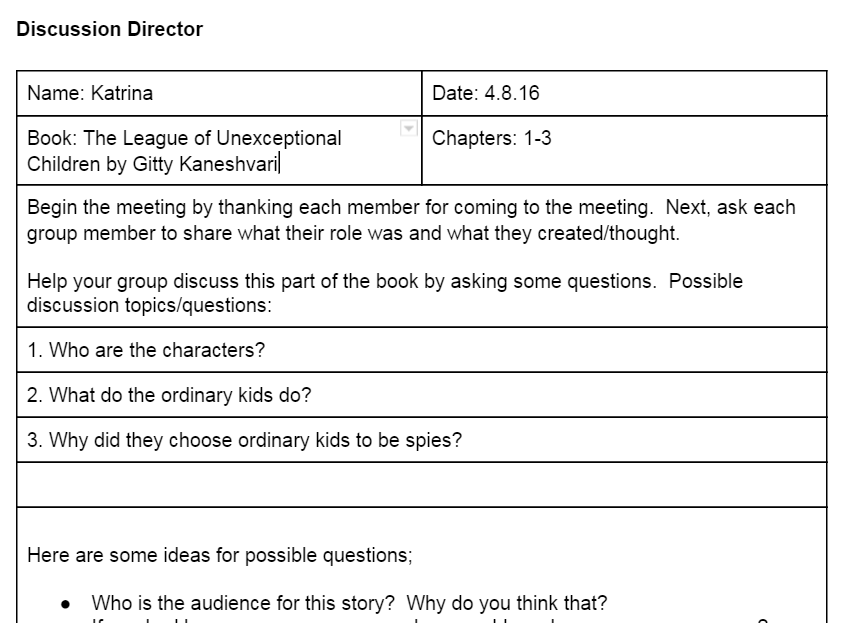
So far, the response has been positive: learners have worked together to clarify roles and provided support to others when preparing for their first meeting - at which they enjoyed rich discussions led by the Discussion Director.


The learners are creating and completing their designated tasks digitally, although this can only be described as substitution within the SAMR model at present. However, the visible co-operation, collaboration and purposeful talk are supporting the growth of actively-engaged learners who, it is hoped, will choose to persevere to become resilient independent readers over time.

Saturday, 9 April 2016

Spark-MIT 2016: What do I want to reflect upon and share at the end of Term 1?

The backstory: although moving with the same student cohort from Year 5 in 2015 to Year 6 in 2016, the number of learners in Room 10 has decreased since the end of 2015 as five students have left the area over the summer holiday and during Term 1.  One student has returned to learn at Ruapotaka after a short time in Room 10 earlier in 2015.


The digital context: as at the 7th April 2016, 59% of Room 10 is learning with Chromebooks. 41% of the class continues personal learning traditionally. There is a digital divide within Room 10. Once 90% (or more) of students have access to a personal Chromebook in Term 2, family and whānau will be invited to share their initial ideas, thinking and expectations about their child’s learning and any opportunities to engage and connect with this within a ubiquitous digital learning environment.

The data so far: just under half of Room 10 read at their chronological age; just over a quarter of the students read at a level well-below their chronological age; no learners are reading above their age. Just over half the class maintained their reading age over the 2015/2016 summer break. For those students whose reading age declined between December 2015 and February 2016, the downward shift was either 6 or 12 months.

Anecdotal evidence about reading habits over the 2015/2016 summer break: two students participated regularly in Dare to Explore, a summer reading programme at Auckland Libraries; approximately half of the class said they read occasionally over the holiday; and around one-third of students did very little or no reading during the summer break.

Sunday, 28 February 2016

Spark-MIT 2016: The problem unpacked

The specific problem of my inquiry was identified, deliberated and refined at Spark-MIT 2016 Day 1: how do my Year 6 learners in a Decile 1 primary school make and sustain accelerated gains in reading?

The easy answer, of course, is to read more. Therein lies the problem: how will that happen?  The cycle of inquiry begins.

My initial thoughts on unpacking the problem have evolved into a series of questions which will focus my inquiry over the course of 2016:


Monday, 22 February 2016

Spark-MIT 2016

Today was Day 1 of Spark-MIT 2016.  This year's cohort of Manaiakalani Innovative Teachers gathered at Spark's Head Office in the city to share the focus of their inquiry, challenge and support each other in finalising their research problem for 2016.