Pages

Showing posts with label Reading. Show all posts

Monday, 28 November 2016

Linking my things: a ThingLink for Spark-MIT 2016


To help join the dots within my Spark-MIT inquiry 2016, I have created a ThingLink to share my inquiry so far in one Digital Learning Object (DLO). Using ThingLink for the first time to create this DLO reminds me of the learners in Room 10 when they are faced with new learning - they challenge themselves and ultimately persevere to make sense and meaning!

Thursday, 24 November 2016

Spark-MIT: Sharing at a staff meeting


On Tuesday there was an opportunity to share my hui and uLearn presentation at a Ruapotaka staff meeting to update my colleagues about my Spark-MIT inquiry: what have I discovered while involving and engaging whānau in their children's learning while trying to cause accelerated gains in their children's reading?

Wednesday, 23 November 2016

Our final Spark-MIT meeting for 2016


This week has seen the final Spark-MIT meeting for the year at Spark HQ - a time of sharing and reflection for our cohort of 11 teachers from within Manaiakalani and its outreach clusters. An updated video of my uLearn presentation shares my reflections.

So what have I achieved through my inquiry since August? Two more families have enjoyed whānau training with Manaiakalani's Whānau Learning Kaiarahi, Yayleen Hubbard. Whānau have begun to engage with blog commenting in response to student-created support resources and homework tasks! Year-end reading data has been collected and analyzed.

So what have I learnt from this data? 57% of the control group (currently 14) has made accelerated gains of 1.5 years in reading achievement since February 2016. Significantly, Alex’s new-found positive attitude to learning combined with whānau engagement and digital affordance caused a 1.5 year shift in reading. This model of engaging whānau with their child’s learning while striving to meet individual student needs will remain the central theme of my teaching practice.

And what next for my inquiry? Learners are excited about blogging through the summer holidays with the launch of the 2017 Summer Learning Journey. Further reading assessment in February 2017 will tell the final chapter of this inquiry’s story.

Wednesday, 5 October 2016

Spark-MIT 2016: sharing at uLearn

As part of the Spark-MIT 2016 cohort, I am inquiring into raising reading achievement while enabling family and whānau to engage with and support their child's digital learning journey. Each of the Spark-MIT 2016 teachers was tasked with sharing key learning and reflections from these individual inquiries to date in a five minute IGNITE presentation at uLearn 2016. Here is my presentation:


Tuesday, 16 August 2016

Spark-MIT 2016: Literature Circles

I am inquiring into how learners in my Year 6 class can make and sustain accelerated gain in reading. Based on my observations and conversations with learners, all fluent readers enjoy reading but do not always actively choose to engage with longer texts independently. Despite some barriers to these learners accessing a range of relevant and interesting books, there are also personal mindset barriers which impact which books learners choose to read and how learners attempt to sustain reading a longer chapter book.  


According to the Ministry of Education, a literature circle is an approach to teaching reading that encourages fluent readers to think about and discuss books, usually longer texts. In such a “book club” a small group read the same novel independently, coming together at certain times to share their opinions, feelings and thoughts with the rest of the group.


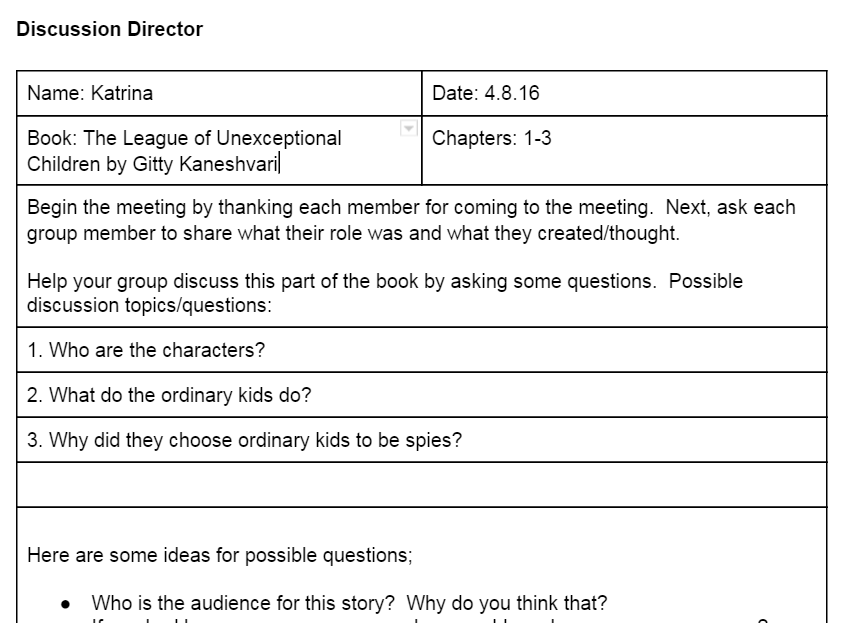
Within the context of this inquiry, one reading group has been introduced to literature circles this term to investigate if this teaching approach can foster independence and deeper connections with a longer text amongst fluent readers. The group has taken on different roles using literature circle resources devised by Sheena Cameron.

So far, the response has been positive: learners have worked together to clarify roles and provided support to others when preparing for their first meeting - at which they enjoyed rich discussions led by the Discussion Director.


The learners are creating and completing their designated tasks digitally, although this can only be described as substitution within the SAMR model at present. However, the visible co-operation, collaboration and purposeful talk are supporting the growth of actively-engaged learners who, it is hoped, will choose to persevere to become resilient independent readers over time.

Saturday, 9 April 2016

Spark-MIT 2016: What do I want to reflect upon and share at the end of Term 1?

The backstory: although moving with the same student cohort from Year 5 in 2015 to Year 6 in 2016, the number of learners in Room 10 has decreased since the end of 2015 as five students have left the area over the summer holiday and during Term 1.  One student has returned to learn at Ruapotaka after a short time in Room 10 earlier in 2015.


The digital context: as at the 7th April 2016, 59% of Room 10 is learning with Chromebooks. 41% of the class continues personal learning traditionally. There is a digital divide within Room 10. Once 90% (or more) of students have access to a personal Chromebook in Term 2, family and whānau will be invited to share their initial ideas, thinking and expectations about their child’s learning and any opportunities to engage and connect with this within a ubiquitous digital learning environment.

The data so far: just under half of Room 10 read at their chronological age; just over a quarter of the students read at a level well-below their chronological age; no learners are reading above their age. Just over half the class maintained their reading age over the 2015/2016 summer break. For those students whose reading age declined between December 2015 and February 2016, the downward shift was either 6 or 12 months.

Anecdotal evidence about reading habits over the 2015/2016 summer break: two students participated regularly in Dare to Explore, a summer reading programme at Auckland Libraries; approximately half of the class said they read occasionally over the holiday; and around one-third of students did very little or no reading during the summer break.

Sunday, 28 February 2016

Spark-MIT 2016: The problem unpacked

The specific problem of my inquiry was identified, deliberated and refined at Spark-MIT 2016 Day 1: how do my Year 6 learners in a Decile 1 primary school make and sustain accelerated gains in reading?

The easy answer, of course, is to read more. Therein lies the problem: how will that happen?  The cycle of inquiry begins.

My initial thoughts on unpacking the problem have evolved into a series of questions which will focus my inquiry over the course of 2016:


Monday, 22 February 2016

Spark-MIT 2016

Today was Day 1 of Spark-MIT 2016.  This year's cohort of Manaiakalani Innovative Teachers gathered at Spark's Head Office in the city to share the focus of their inquiry, challenge and support each other in finalising their research problem for 2016.